HOME
Machina Dynamica's Nimbus Sub-Hertz Platform (No Longer Available)
World's Only Single Airspring Isolation Platform
Theory of Operation
Sub-Hertz Performance
Machina Dynamica's Nimbus Sub-Hertz Platform is a unique, 6 degree-of-freedom isolation device with extremely low resonant frequencies - as low as 0.5 Hz. Nimbus isolates the component from "large-scale effects" such as footfalls and traffic-generated vibration as well as the everyday low level microseismic type vibration that's much less obvious. Nimbus' unusual design characteristics are examined in the following paragraphs.
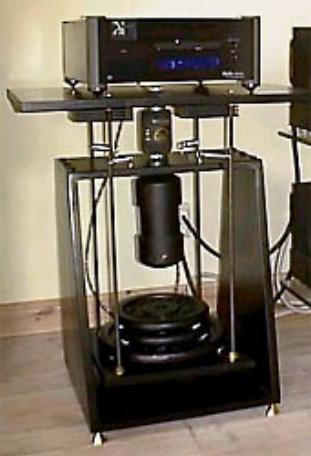
Black Nimbus showing Firestone air spring,
extra-large
auxiliary air reservoir, coil spring lateral support system,
hardened steel rods connecting top plate to lower plate,
Selective Frequency Dampers attached to underside of
top plate and underslung ballast weight on lower tray.
Floppiness and Instability
Nimbus is the world's only pneumatic isolation platform to employ a single air spring. This approach minimizes Nimbus resonant frequencies and maximizes the number of directions of isolation (Nimbus isolates in 6 directions of motion). Lateral stiffness for the tall floppy Firestone air spring is achieved only by incorporating both a coil spring lateral support system and a ballast weight system (to lower the system mass center of gravity). The single air spring (unipivot) design allows Nimbus to isolate the component in all 6 directions of motion - the vertical direction, all horizontal directions, and all three rotational directions (around the x, y and z axes). Nimbus achieves resonant frequencies around 0.5 Hz in the rotational directions and 2 Hz in the vertical direction and 1 Hz in the horizontal plane.
Seismic Vibration, a Brief Recap
Microseismic vibration is the very low frequency vibration produced by the constant movement of the Earth's crust. Other sources of vibration include traffic, subways, wind and tides.
% Transmission and Resonant Frequency
An isolation device with resonant frequency of 3 Hz is only partially effective for vibration in the 3-10 Hz range due to the gradual slope of the low-pass filter function -- % transmission of vibration at 10 Hz is about 12%, while % transmission at 5 Hz is about 50%! By contrast, Nimbus' % transmission at 10 Hz is around 1-3% and at 5 Hz around 5-10% for most directions of motion. Furthermore, most other isolation devices are not free to move in all 6 directions due to constraints in their design that further limit performance.
A Wave Travels Under it
What are the "Directions of Motion" and why are they important? The Earth's crust movement (and other low frequency vibration generators like subways, buses, tides, wind, etc.) produces powerful mechanical waves that travel horizontally over the Earth's surface, a lot like shaking out a rug or waves traveling on the surface of the ocean. Imagine a boat on the ocean with a wave traveling under it. The wave forces the boat to move up and down, but also pushes the boat to and fro, or side to side (horizontal motion). Depending on the direction of the wave, it also causes the boat to "pitch" or "roll" or "twist" (rotational motion). The vertical, horizontal and rotational forces of a wave are illustrated below.
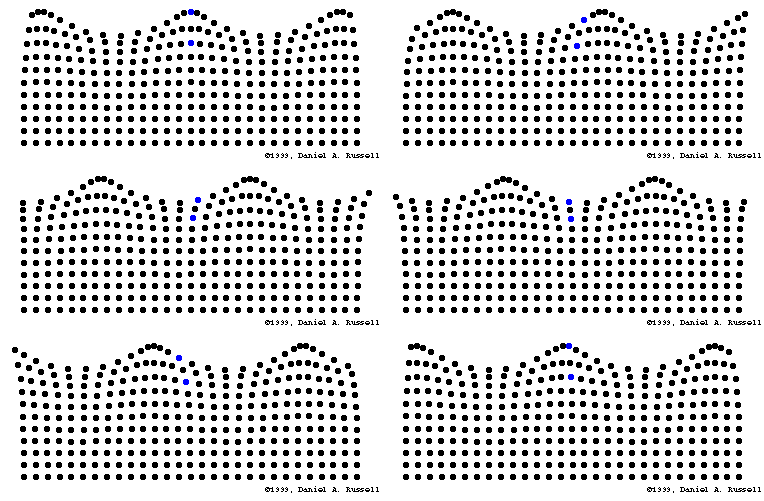
Object (Blue Dot) is Forced to Rotate as Well as Move in Vertical and Horizontal Directions by Wave Action
Two Isolation Systems in One! - The Pendulum and Gravity Feedback Loop
Nimbus' "unipivot" (single air spring) design has a number of interesting characteristics perhaps not obvious at first glance. The Nimbus subchassis consists of the top plate/component and lower plate/ballast + connecting rods; this subchassis behaves like a pendulum, with its pivot point at the top of the Firestone air spring. The 25 lb ballast on Nimbus' lower plate is the pendulum mass. The pendulum behavior of the Nimbus subchassis serves to isolate the component in the horizontal and two rotational directions, supplementing the isolation characteristics of the Firestone air spring/mass system. A characteristic of this pendulum isolator is that the force of gravity acts as a feedback loop to damp the motion of the pendulum subchassis - when seismic vibration (some percentage naturally makes it up through the mass/spring isolation stage) forces the subchassis to move ever so slightly away from its equilibrium position, the force of Earth's gravity on the 25 lb Ballast Mass acts to restore the subchassis, including the component, to its equilibrium position. Thus, Nimbus can be viewed as a "semi-active" isolation device, with the Earth's gravity acting as the "semi-active" restoring force for the pendulum system.
World's Best Air Spring
The Nimbus uses the World's Best air spring, made by Firestone. This air spring possesses ideal geometry and physical characteristics. This Firestone air spring is a convoluted type (folds within itself) that has a thick fabric that will not leak over time. The thin rubber "fabric" of air bladders in most other pneumatic devices allows the pressurized air to leak directly through it over time, requiring more frequent air replenishment and affecting sonic performance as the system continually readjusts for lower and lower internal air pressure and uneven pressures in the bladders/air springs. An extra-large auxiliary air reservoir is fitted to the Firestone air spring to reduce spring rate and improve Nimbus' isolation effectiveness. The single air spring design completely avoids an important but overlooked problem of other air spring/bladder isolation systems -- the multiple air springs/bladders interfere with each other. Sesimic vibration forces some of the air springs/bladders to compress, which in turn forces the others to expand, ad infinitum. This mutual interference causes "pumping" in the pneumatic system and is quite audible compared to Nimbus. Nimbus produces sound that is supremely dynamic, extended and transparent compared to most other isolation devices.

Nimbus isolates G&D Transforms CD Transport in system w/ JC-1s driving Rockport Syzygy speakers,
CTC Blowtorch preamp and Entec Number Cruncher DAC as well as BBQ amp and Bybee filters,
not to mention Rockport Capella Turntable w/ Clavis DC.
Lateral Support System
Ballast weight on the Nimbus lower tray is required to obtain sufficiently low center of gravity for the system, given the "floppy" nature of the Firestone air spring, even when pressurized. A complex lateral support coil spring system provides additional lateral support (stiffness) for the Firestone air spring/auxiliary reservoir and acts as an isolating device itself (for horizontal directions). Ballast is 25 lb steel barbell weight, symmetrical in shape with very high stiffness.
What to Isolate?
Nimbus is intended for CD and SACD players, DACs, turntables, amps, preamps up to about 35-40 lb. All components should be isolated for optimum system performance. Machina Dynamica sells Promethean Isolation Base, a low-profile mechanical spring based stand, for heavier components.